
The portal flickers again. The terrain re-renders. This time, familiar settings materialize: clinics, classrooms, offices. The world of AI is no longer distant. It’s embedded all around us.

Editor's note: AI evolves quickly. We did our best to source information from public websites, whitepapers, and leadership statements regarding the tools discussed. We even linked them for you to investigate and verify yourself. However, much of this work is obscured within private organizations, making full verification difficult. As such, we cannot take responsibility for any misrepresentations that may result. If you are aware of updates or discrepancies, please comment below.
Welcome to the Fourth Issue of the Ongoing Series
In Newsletters #001–#003, we laid the conceptual groundwork for AI literacy: what AI is, how it learns, and how to critically evaluate its outputs. This week we shift focus: What’s already happening in the real world of behavior analysis?
Spoiler: Plenty.
AI is no longer a futuristic add-on. It’s embedded in the tools you and your team already use. Sometimes without your knowledge and often without peer-reviewed validation of its accuracy or safety.
This issue highlights the four domains where AI has quietly taken root.
Clinical Decision Support & Direct Care
Why it matters: AI promises to expand our abilities to analyze the four-term contingency: MO → Environmental Stimuli → Behavior → Consequence. Done well, it reduces latency in program adjustments, flags patterns that might escape human eyes, and tailors all aspects of treatment to the individual.
What do we know is live right now:
-
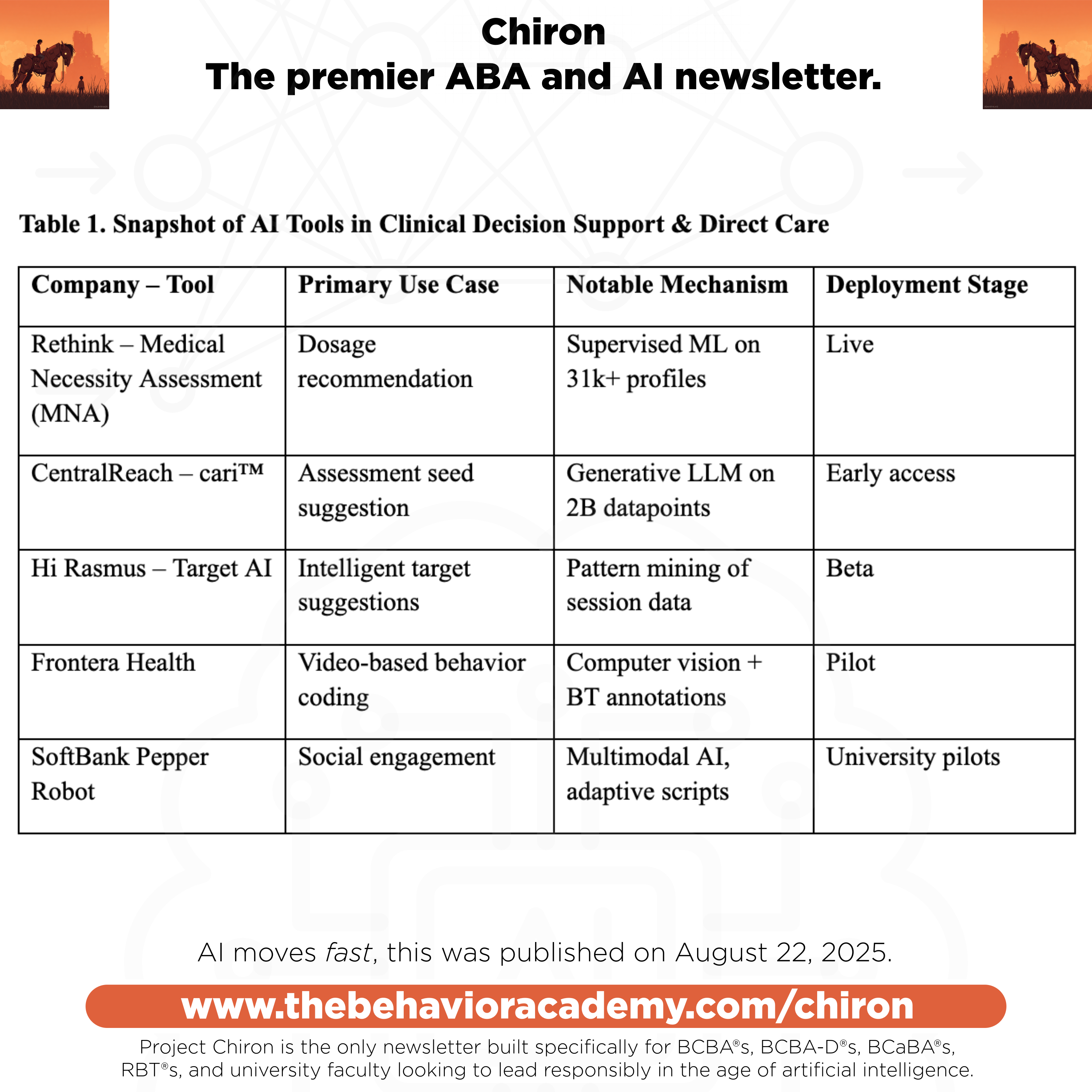
Rethink – Uses the world’s largest published ABA dataset to recommend service hours (Medical Necessity Assessment). (LINK)
-
Rethink – Predicts goal-mastery trajectories across 31,000+ learner profiles. (LINK)
-
CentralReach – cari™ – Suggests ABLLS-R® or AFLS® starting points based on 2B+ clinical datapoints. (LINK)
-
Hi Rasmus – Piloting goal suggestions from real-time session data. (LINK)
-
Frontera Health – Uses computer vision to auto-tag subtle behaviors from 30fps video. (LINK)
-
SoftBank Pepper – Socially assistive robot delivering gamified social interactions in postsecondary and adult programs. (LINK)
Critical questions for BCBAs
-
What dependent variables is the model optimizing?
-
Is the training data representative of your learners?
-
If the algorithm contradicts your FA, who wins—and why?
-
Do fast recommendations encourage premature program changes?
Administrative Automation
Why it matters: Schedulers, billers, and coordinators may not draw headlines, but they shape client access to care. AI tools that govern these systems influence who gets therapy, when, and how consistently.
What’s live right now:
